Light supporting modules
The light-domain machinery the catalog modules (effects, modifiers, layouts, drivers) lean on — not directly user-facing. Every row links to its generated technical page (the full API, from the .h) and its tests. Cross-cutting rationale that no single .h owns lives in the prose sections below the table.
| Name | Preview | Controls | Links |
|---|---|---|---|
| Layer One rendering layer — an effect writes into its buffer, modifiers transform the coordinate mapping, and the layer composites onto the shared output. The unit the render loop iterates. |
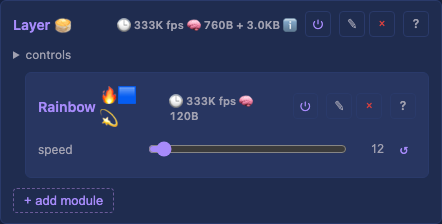 |
blendMode — how this layer composites onto the ones below (overwrite / alpha / additive). |
Tests Technical |
| Effects The container of layers — composites them (blend mode + opacity per layer) into the final light buffer. |
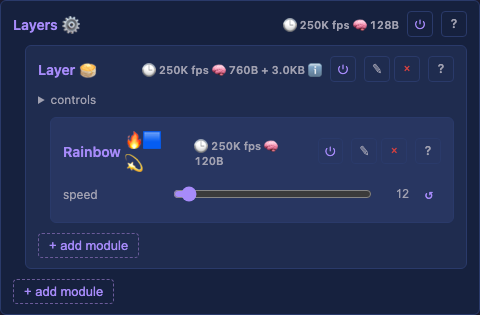 |
— | Tests Technical |
| Layouts The container of layout modules — walks each layout's coordinates to build the physical light set the mapping consumes. |
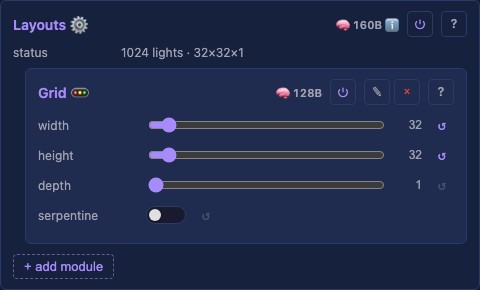 |
— | Tests Technical |
| Drivers The container of driver modules — owns the shared driver buffer and the per-light output correction every driver applies before sending. |
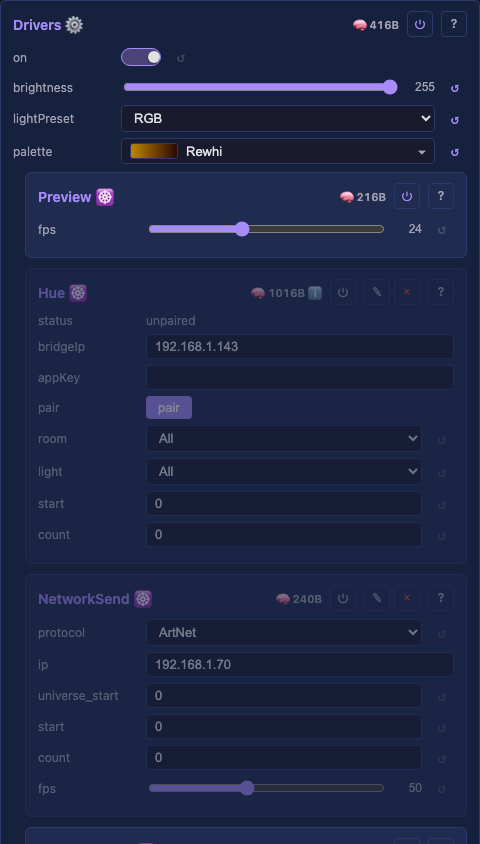 |
on — master power (default on). Off scales the output to black while preserving brightness, so on restores the exact level. The one power control every consumer drives (the UI, IR, the WLED app / Home Assistant, MQTT).brightness — global output brightness (0–255), multiplied with each driver's own localBrightness.palette — the active palette effects sample from.multicore — run the output stage on the second core (default on), so a frame costs max(render, output) instead of render + output. Falls back to single-core by itself if the extra frame buffer won't fit. On is the better configuration; the switch is there to A/B it.renderWait — read-only: how long core 0 waited for core 1 at the frame boundary. Near zero means render and output overlap well; a large value means core 0 is idling on a slow output stage. Shown only while multicore is on. |
Tests Technical |
| LightPresets The named channel wirings drivers reference — which channel carries Red, Green, Blue, White, or a fixture role like Pan/Tilt. Real fixtures ship read-only (the color orders, multi-channel pars, moving heads); add your own alongside them. A driver stores a preset's stable id, not its name, so renaming or reordering never breaks a reference. |
— | presets — the editable list of preset definitions. Each row: a name, a channel count, and one role picker per channel. Built-in rows are read-only; custom rows are fully editable and persist across reboot. |
Technical |
| Buffer Contiguous light-data buffer, shared between the layers that write it (effects) and the driver groups that read it. A raw uint8_t* so any channel layout fits — RGB, RGBW, multi-channel DMX. |
— | — | Tests Technical |
| MappingLUT Maps the virtual grid to the physical sparse light set — a radius-4 sphere becomes its 210 real lights, not the 729-cell box. The lookup effects and the preview both consume. |
— | — | Tests Technical |
| Effect base The EffectBase class every effect derives from — the shared surface (buffer access, dimensions, the palette) an effect renders against. |
— | — | Technical |
| Modifier base The ModifierBase class every modifier derives from — transforms the coordinate mapping (mirror, rotate, multiply, …) a layer applies before rendering. |
— | — | Technical |
| Driver base The DriverBase class every driver derives from — the shared surface (the driver window, the source buffer, the output correction) a driver reads before sending its slice. |
— | — | Technical |
| Layout base The LayoutBase class every layout derives from — the shared surface a layout implements to walk its coordinates into the physical light set the mapping consumes. |
— | — | Technical |
| Slot encoder Turns lights into WS2812 bus words: each data bit becomes three bus slots (pulse start / data / tail), and the data slot is an 8×8 bit transpose — lanes in, bit-planes out. Shared by every parallel driver, and the render loop's measured hot spot. |
— | — | Technical |
| Pin list Parses the pins and ledsPerPin controls: GPIO lists, and the broadcasting rule that spreads a window over strands (empty = even split, one number = that many each, a list = one per strand). |
— | — | Technical |
| Parallel LED driver base The ParallelLedDriver base every parallel WS2812 driver derives from — the shared body: strand slicing, the fused correct+encode, the latch pad, and the single-shot DMA transfer. Each driver adds only its peripheral's pieces. |
— | — | Technical |