MoonDeck
The developer console: one page that builds, flashes, runs, tests and monitors across every target, and discovers devices on the network. The per-script reference is MoonDeck.md. What follows is why it is shaped this way.
The shape comes first, then why the scripts are ours, then where the state lives.
One script per task, two front ends
flowchart LR
    task["<b>a task</b><br/><i>build · flash · test · check</i>"]
    script["<b>one Python script</b><br/><code>moondeck/group/name.py</code>"]
    cli["<b>the CLI</b><br/><i>agents and CI</i>"]
    ui["<b>the console</b><br/><i>a human, at :8420</i>"]

    task --> script
    script --> cli
    script --> ui

    classDef po fill:#2d3561,stroke:#7b88c9,color:#fff
    classDef agent fill:#3d2d61,stroke:#a07bc9,color:#fff
    classDef check fill:#1f4d3d,stroke:#5fb89a,color:#fff
    class task po
    class script agent
    class cli,ui check
Every action the console offers is a thin wrapper around a script, so uv run moondeck/build/build_desktop.py and the button run the same code. That is the whole design: one implementation, two ways in, and no path where a human and an agent measure something differently.
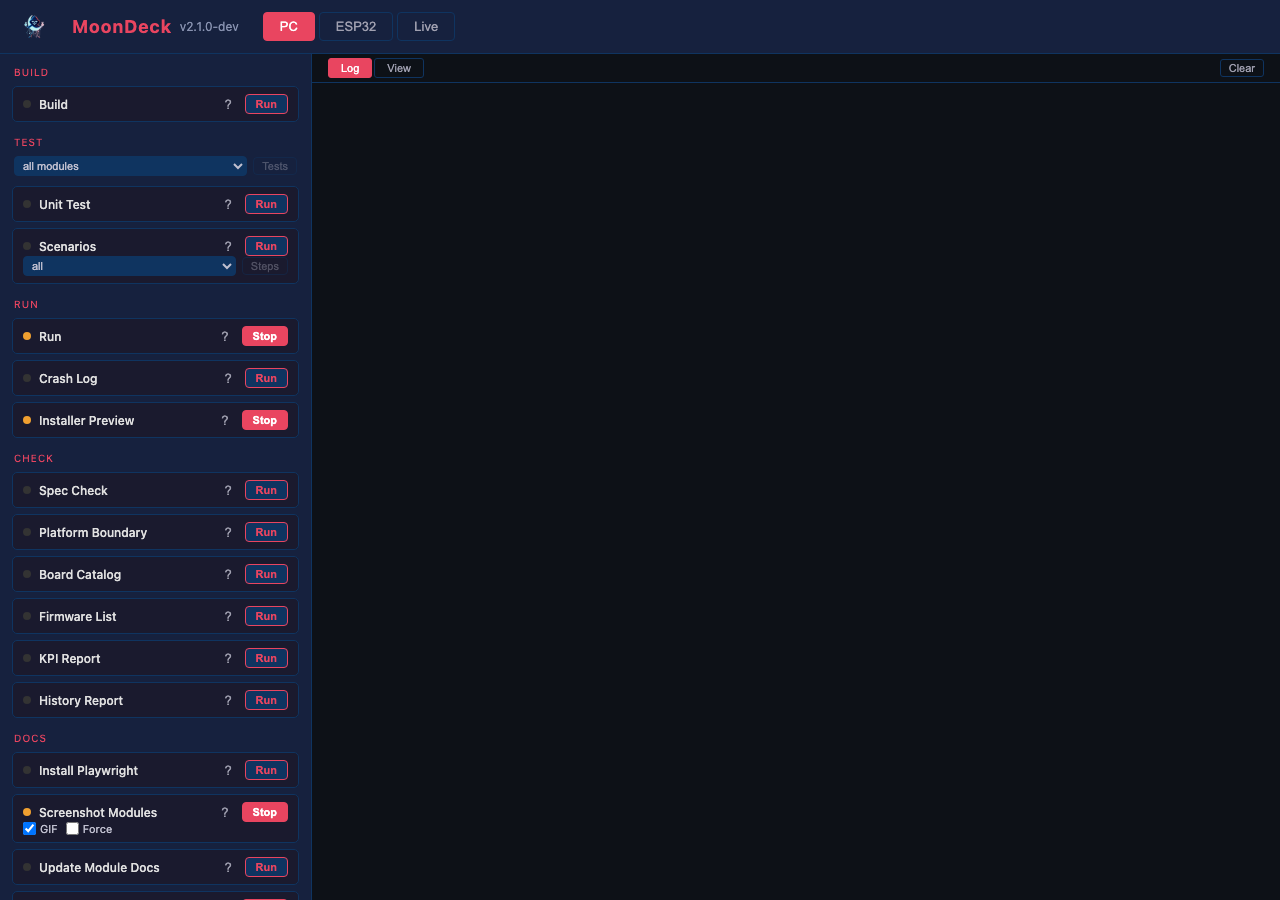
The script is the contract. It picks the right per-host build directory, applies the flags the gate expects, and tees its output where the report reads it. Reaching past it to cmake or idf.py produces a number measured differently, or a stale binary the script would have rebuilt.
Why our own scripts
The firmware builds vendor-native against pinned ESP-IDF versions, and the tooling covers far more than compile-and-flash: desktop builds, unit and scenario runs, spec and boundary checks, KPI collection, provisioning, multi-board bench orchestration. A wrapper toolchain would cover one of those and still need the scripts around it. The full reasoning is in building.md.
State, and where it lives
Script definitions are committed in moondeck/moondeck_config.json. Runtime state, meaning the selected network, the known devices and the last-used serial port, lives in moondeck/moondeck.json and is gitignored: it describes one developer's bench rather than the project.
Networks are the unit of bench state. Each holds its own device list, serial port and WiFi credentials, and the console auto-selects the network whose subnet matches the host, so moving a laptop between networks usually needs no clicks.
The device-model picker reads the installer's catalog. The same deviceModels.json the web installer uses, so a device configured through either route ends up with the same module tree. Selecting a model pushes its full config: add the modules, then set their controls.
Logs and run counts under build/moondeck-logs/ are derived state. Deleting build/ resets them, and a missing file costs the count rather than the run.