VuMetersEffect
Source:
VuMetersEffect.h
VuMetersEffect
src/light/effects/VuMetersEffect.h:26Inherits:
EffectBase
Effect: sixteen VU needles with real mass, one per band, with peak-hold and a red zone.
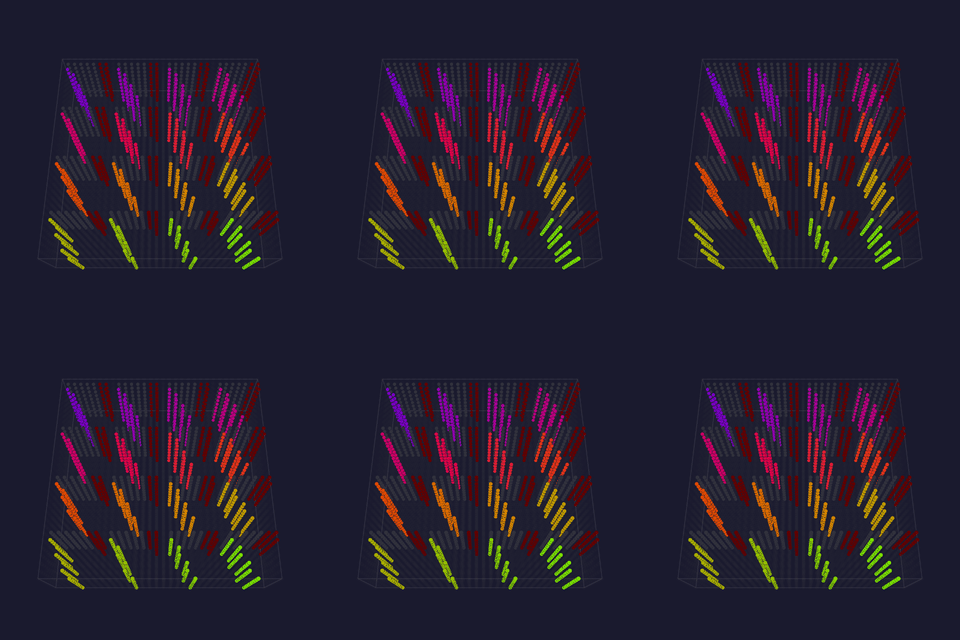
What makes a VU meter beautiful is the needle's mass rather than the dial. A physical meter is a spring and a damper, so the needle overshoots a peak and settles back. That overshoot is why a mechanical meter reads as alive where a bar graph reads as a readout.
Prior art: IEC 60268-17, which specifies 300 ms to 99% with 1 to 1.5% overshoot.
Public Attributes
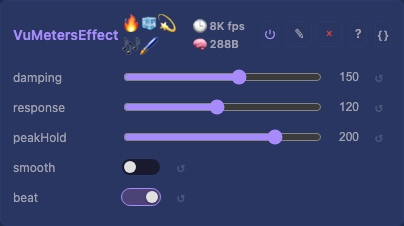
uint8_t damping = 150
: How much the needle overshoots: low swings, high is critically damped.
uint8_t response = 120
: How quickly the needle chases the signal at all.
uint8_t peakHold = 200
: How long the peak marker stays up.
bool smooth = false
: Drive from the smoothed ballistic rather than the raw band.
Public Methods
virtual inline const char * tags() const override
: Catalog tags for the visual catalog.
virtual inline Dim dimensions() const override
: A plane of dials, where a cube gets one bank per slice.
virtual inline void defineControls() override
: Publish the needle's mechanics and the peak-hold.
virtual inline void prepare() override
: Rest every needle and clear its peak.
virtual inline void tick() override
: Integrate every needle, then tile the bank and draw each dial.
More info
Each band drives a damped harmonic oscillator
damping sets the overshoot: high is a critically damped studio meter, low a loose needle. The bass needles are heavier than the treble ones, as on a real multi-meter bridge. So the low end swings where the high end flickers.
Each needle sweeps its own arc in its own cell, with a red zone past three quarters. A peak marker holds the highest reading and falls slowly, which is the standard meter's other half.