StarFieldEffect
Source:
StarFieldEffect.h
Star
src/light/effects/StarFieldEffect.h:145One star: a position in space and its own palette index.
Public Attributes
float x
float y
float z
uint8_t colorIndex
StarFieldEffect
src/light/effects/StarFieldEffect.h:32Inherits:
EffectBase
Star-field effect: drifting points like flying through stars.
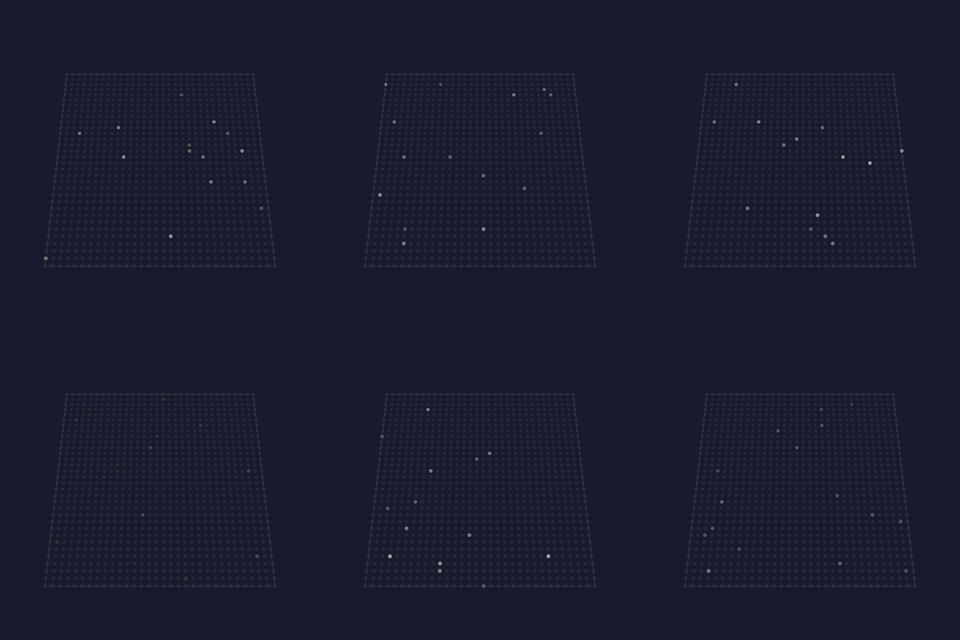
 Author: @Brandon502 (MoonLight), inspired by Daniel Shiffman / Coding Train, https://www.youtube.com/watch?v=17WoOqgXsRM , https://github.com/ewowi/MoonLight/blob/main/src/MoonLight/Nodes/Effects/E_MoonLight.h
Each star is a 3D point drifting toward the viewer, re-projected onto the panel every advance. So a near star splays outward and flies off the edge while a distant one sits near the center. That is the classic warp look, and a star passing the camera respawns at the far plane.
Prior art: MoonLight's StarField, whose model and respawn rule this reproduces.
Public Attributes
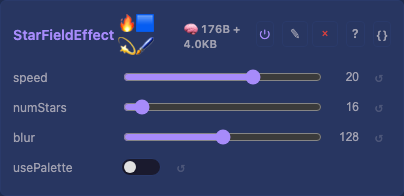
uint8_t speed = 20
: How fast the field advances, where 0 pauses it.
uint8_t numStars = 16
: How many stars are active.
uint8_t blur = 128
: The fade rate, where a stronger fade leaves shorter streaks.
bool usePalette = false
: Color the stars from the palette rather than in grayscale.
Public Methods
virtual inline const char * tags() const override
: Catalog tags: MoonLight origin.
virtual inline Dim dimensions() const override
: Writes the z=0 slice.
virtual inline void defineControls() override
: Publish the flight speed, the population, the streaks and the coloring.
virtual inline void prepare() override
: Size the star table to the control's maximum, re-seeding only when the grid changes.
virtual inline void tick() override
: Fade the streaks, then advance and re-project every star when a step is due.
More info
Depth drives brightness, and the fade draws the streak
A nearer star is brighter, and with usePalette its depth picks the hue too. blur fades the previous frame rather than clearing it, so each star leaves a motion streak. speed throttles how often the field advances, and 0 pauses it.
The port is exact on purpose
The per-star perspective divide keeps floats, running once a star rather than once a pixel. The center offset and the projection scale are integer halves, so an odd-width panel matches. A ported effect that looks different is a regression, so fidelity wins over tidiness here.