FireworksEffect
Source:
FireworksEffect.h
FireworksEffect
src/light/effects/FireworksEffect.h:31Inherits:
EffectBase
Effect: shells that rise, stall, and burst into falling sparks.
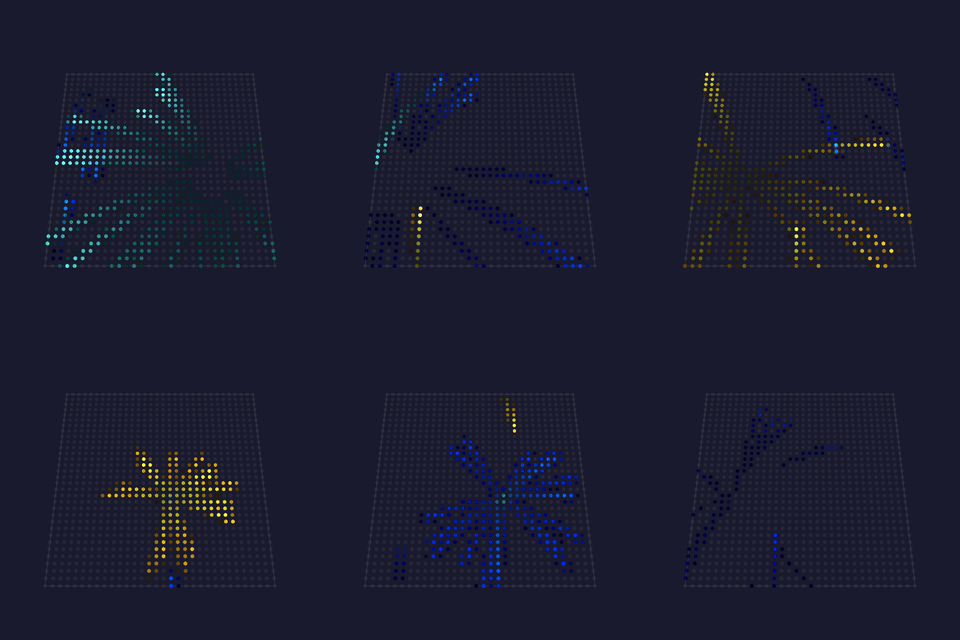
The particle kernel end to end, where every stage of a firework is one kernel call. The effect itself decides only when to launch and in what color.
Prior art: the WLED Particle System's firework family, where the physics here is the kernel's.
Public Attributes
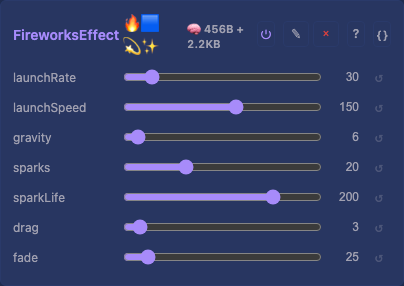
uint8_t launchRate = 30
: How often a new shell goes up.
uint8_t launchSpeed = 150
: How hard a shell is thrown, and so how high it bursts.
uint8_t gravity = 6
: How fast everything falls.
uint8_t sparks = 20
: How many sparks each burst throws.
uint8_t sparkLife = 200
: How long a spark survives.
uint8_t drag = 3
: Air resistance, which flattens the arc.
uint8_t fade = 25
: Trail length, which is the Layer's decay rather than the pool's.
Public Methods
virtual inline const char * tags() const override
: Catalog tags: this effect is the power-function showcase.
virtual inline Dim dimensions() const override
: Writes the z=0 slice, which extrude fills through a volume.
virtual inline void defineControls() override
: Publish the launch, the physics, the burst and the trail.
virtual inline void prepare() override
: Size the spark pool and reset the shell.
virtual inline void tick() override
: Simulate this frame's slice of time, then draw the sparks and any rising shell.
More info
Nothing schedules the apex
A shell is spawned with upward velocity, and gravity acts on it every frame. The burst fires when its vertical velocity crosses zero, so the physics decides where. That is why a faster launch bursts higher without a second control.
Each stage is a kernel call
spawn launches, gravity slows the rise, and angleEmit bursts a ring where it stalled. Gravity and drag then shape the fall, and age fades a spark as it dies. Trails come from the Layer's own decay rather than a second one hidden in the pool. Cost is one pass per force over a pool the effect sizes itself, plus a splat per live spark.