DissolveEffect
Source:
DissolveEffect.h
DissolveEffect
src/light/effects/DissolveEffect.h:27Inherits:
EffectBase
Effect: two color fields trading places pixel by pixel, with no per-pixel state.
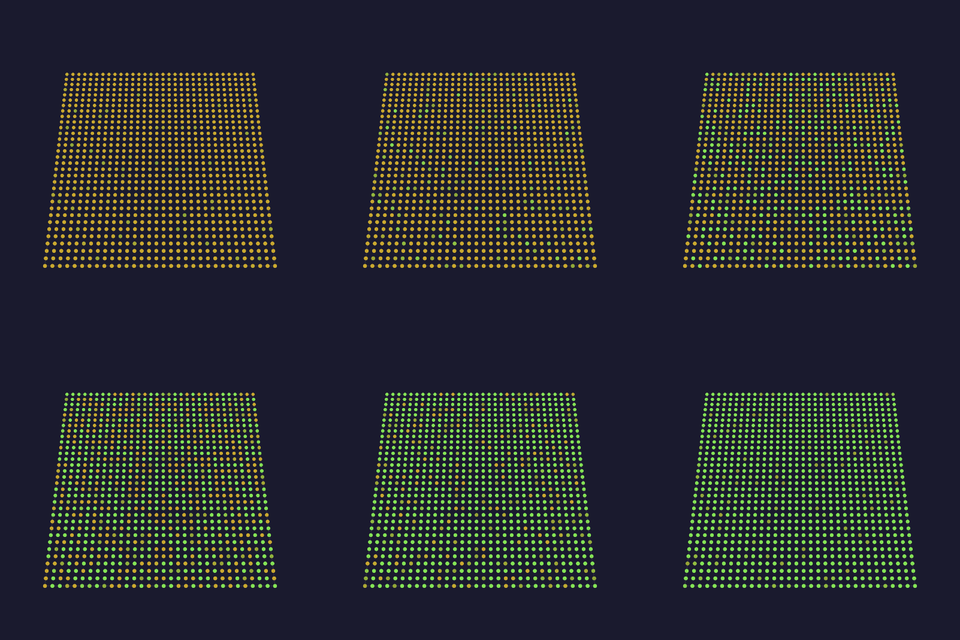
The order looks random but is computed rather than stored. Each pixel asks a hash of its own position for a threshold, and compares it against the progress.
Prior art: the classic dissolve, where the position-addressed form is the shader approach.
Public Attributes
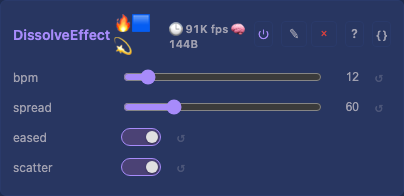
uint8_t bpm = 12
: How fast one transition completes.
uint8_t spread = 60
: How long a pixel spends mid-flight, where 0 gives a hard edge.
bool eased = true
: Ease the progress rather than sweeping it linearly, which reads as mechanical.
bool scatter = true
: Dissolve in a scattered order, or wipe positionally when off.
Public Methods
virtual inline const char * tags() const override
: Catalog tags: this effect is the power-function showcase.
virtual inline Dim dimensions() const override
: Writes the z=0 slice, which extrude fills through a volume.
virtual inline void defineControls() override
: Publish the transition's speed, its softness and its order.
virtual inline void tick() override
: Compare each pixel's own threshold against the transition's progress.
More info
The point is what it does not need
A dissolve normally shuffles a list of pixel indices, which costs memory and must stay in step. Here there is no array, no shuffle and no per-pixel state. Two devices agree without exchanging anything, since the hash is a function of position.
That is the supersync property: a stream generator advances per call and drifts, and this cannot.
Cost is one hash and one compare a pixel, with nothing scaling beyond the pixel count.