DevicesModule
Source:
DevicesModule.h
Device
src/core/system/DevicesModule.h:226One discovered device, as the list serializes it.
Public Attributes
uint8_t ip = {}
char name = {}
DevType type = DevType::Generic
bool self = false
bool cached = false
: restored from persistence, not yet re-heard live this session.
uint32_t lastSeenMs = 0
: [platform::millis()] at the most recent presence sighting.
uint8_t colorCount = 0
: Hue bridge only: how many of its lights are color-capable.
DevicesModule
src/core/system/DevicesModule.h:48Inherits:
MoonModule,ListSource
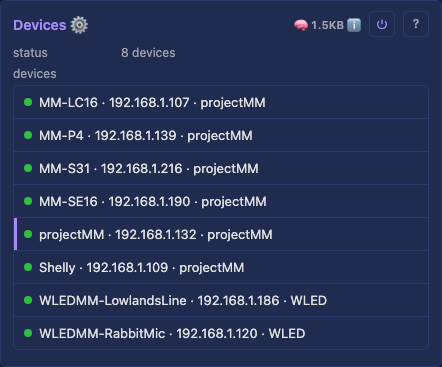
Discovers other devices on the LAN and presents them as a browsable list.
It covers every device on the network, this one included and marked as such. Core and domain-neutral: it finds a device, and light modules consume the list. A submodule of the network module, discovery depending on the network being up.
Public Attributes
bool wledCompatible = false
: Whether to announce on the broadcast address as well as the multicast group.
Public Methods
inline void setSelfName(const char * name)
: Adopt this device's own name, so its own row matches what everything else shows.
virtual inline uint8_t listRowCount() const override
: How many devices are currently listed.
virtual inline void writeListRow(JsonSink & sink, uint8_t row) const override
: Append one device's summary: its name, address and kind.
virtual inline void writeListRowDetail(JsonSink & sink, uint8_t row) const override
: Append one device's detail, which adds its address and how long since it was heard.
virtual inline bool restoreList(const char * json, const char * key) override
: Rebuild the list from the saved array, so the last-known set shows before any packet.
virtual inline void defineControls() override
: Declare the compatibility toggle and the list of discovered devices.
inline void upsertHueBridge(const uint8_t ip, const char * name, uint8_t color)
: Register a bridge a driver found out of band, updating its row or inserting one.
virtual inline void setup() override
: Report the cached list on boot, which persistence restored before this ran.
virtual inline void prepare() override
: Claim the seat that makes this the instance a driver registers through.
virtual inline void release() override
: Vacate the seat and close the socket, which releases its port.
virtual inline void tick1s() override
: Drain inbound packets, announce ourselves on a slow cadence, and age out the silent.
virtual inline ModuleRole role() const override
: Role for type identification (no RTTI needed).
inline void injectPacketForTest(const uint8_t * data, size_t len, const uint8_t srcIp)
: Feed one packet through the real pipeline, so a test needs no network.
Public Static Methods
static inline DevicesModule * active()
: The one live instance, through which a light-domain driver registers what it found.
More info
Discovery is passive
Each device broadcasts a small presence packet, and this listens for them. There is no subnet sweep: a device appears when heard, and ages out when it stops. We announce ourselves on a slow cadence, so peers discover us.
Plugins are the interop seam
A foreign ecosystem hooks in as a plugin rather than a branch. Each declares its port and turns a datagram into a device kind, ours offered first. A new system is one new file, and a device found out of band registers through a seam.
Ageing out, and persistence
Each sighting is stamped, and a live-confirmed device is kept as durable history. A row restored from persistence gets a short probation, so a ghost cannot persist. The list persists, so the last-known set shows on boot before any packet arrives. This module does discovery only, never device-to-device commands.