AudioService
Source:
AudioService.h
AudioService
src/core/services/AudioService.h:45Inherits:
MoonModule
Acquires an audio source and publishes a frame: a level, sixteen bands, and the peak.
The producer half of the audio-reactive pipeline, which every audio effect reads. Named for what it does, acquisition plus analysis, rather than for one source.
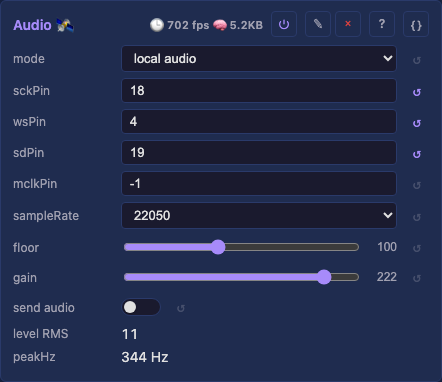
Public Attributes
uint8_t prevBands_ = {}
: the previous block's bands, the flux's reference
BandConditioner cond_
: the per-band floor and peak tables, learned live
LevelConditioner levelCond_
: the same, for the overall level (VU) in automatic mode
OnsetDetector onset_
: the hit decision, with its running mean and refractory
uint8_t device = 0
: Which capture device to open, where the host offers a choice.
uint8_t micMode = 0
: Which kind of microphone is wired, the two-wire kind having no clocks to set.
int8_t sckPin = -1
: the bit clock, or -1 while unset
int8_t wsPin = -1
: the word select, or -1 while unset
int8_t sdPin = -1
: the data line, or -1 while unset
int8_t mclkPin = -1
: The master clock a converter may need, a self-clocked part leaving it unset.
uint8_t sampleRateSel = 2
: Which of the standard rates to run at, a choice rather than a free number.
uint8_t floor = 100
: The silence threshold: below it a band reads as nothing.
uint8_t gain = 128
: The window's width, a higher value running the display hotter.
uint8_t levels = 1
: Who sets the display window: the two sliders, or the learner.
uint8_t simulate = 0
: Which synthesized pattern to produce: a plausible song, or a deterministic march.
uint8_t mode = 0
: The source: a synthesized signal, the network, or its own input.
bool send = false
: Whether to broadcast the local analysis, which only the local mode can do.
uint16_t syncPort = WLED_SYNC_PORT
: The port both directions use, which must match on both ends.
Public Methods
inline void finishBands()
: Finish a block of raw bands:
virtual inline ModuleRole role() const override
: A service, so the container accepts it as a child.
inline uint8_t sync() const
: What the sync machinery does:
inline uint32_t sampleRate() const
: The selected rate in hertz.
virtual inline void defineControls() override
: Declare the mode, then only the controls that mode needs.
virtual inline bool affectsPrepare(const char * name) const override
: Which changes rebuild the channel, rebind the socket, or re-toggle the rows.
virtual inline void prepare() override
: Claim the frame seat, then acquire only the hardware the current mode needs.
virtual inline void setup() override
: One-time wiring only: the acquire and the election live in the build.
virtual inline void release() override
: Free the peripheral and the socket, and vacate the seat for any survivor.
inline const AudioFrame * audioFrame() const
: The latest analyzed frame, always valid, so a consumer without a mic reads silence.
inline bool syncOpenForTest() const
: Whether the sync socket is open.
inline bool micStatusStaleForTest() const
: Whether a mic diagnosis is outstanding, which suppresses the sync line while it is.
inline void setMicStatusStaleForTest(bool stale)
: Set the flag a local-mode diagnosis would have set, so leaving that mode can be tested anywhere.
inline const char * syncStatusForTest() const
: The sync state as the card shows it, which is the reported state itself.
inline uint32_t syncSendCountForTest() const
: How many sends have gone out.
virtual inline void tick() override
: Produce this tick's frame, from the network, a synthesizer, or the local input.
inline void synthesizeFrame(bool sweep)
: Fill frame_ with a synthesized signal.
virtual inline void tick1s() override
: The once-a-second tick for housekeeping, which by default ticks the children.
Public Static Attributes
constexpr size_t kBlock = 512
: The block and transform size, a power of two, around twenty milliseconds of audio.
constexpr size_t kMag = / 2
: How many magnitude bins that produces.
constexpr uint8_t kRatio = 4
: How much of a band's deviation to correct, short of the ratios that pump.
constexpr uint8_t kMaxGainDb = 24
: How far a band may be lifted, so a silent one is never amplified into its own noise.
constexpr uint8_t kSimMode = 0
: A synthesized signal, so a device demonstrates sound before anything is wired to it.
constexpr uint8_t kReceiveMode = 1
: Another device's analysis, over the network that has to exist to carry it.
constexpr uint8_t kLocalMode = ? 2 : 1
: This device's own microphone, which needs pins and a part to be connected to them.
constexpr uint16_t kSampleRates = {8000, 16000, 22050, 44100}
: The rates the selector offers.
constexpr uint8_t kSampleRateCount = 4
: How many there are.
Public Static Methods
constexpr static inline constexpr uint32_t syncSendIntervalMsForTest()
: How often a send may go out.
constexpr static inline constexpr uint32_t syncFallbackMsForTest()
: How long a peer may be quiet before it is stale.
constexpr static inline constexpr uint32_t syncOpenRetryMsForTest()
: How long a failed open waits.
static inline const AudioFrame * latestFrame()
: The live frame every consumer reads, or silence where there is no source.
More info
The modes run simple to advanced
Simulate synthesizes a signal for a demo or a test. Receive is a sink a peer drives. Local runs the device's own input and analyzes it here. A device is exactly one of these, and changing it acquires or releases hardware live.
They are ordered by what each one needs: simulate needs nothing, receive needs a network, local needs a part wired to pins. So the default is the first entry rather than an index that depended on the platform, and a device demonstrates sound before anything is attached to it.
The pipeline
Each block: read, block the offset, measure the level, window, transform, map to bands. The high-pass conditions the block once, so both halves see the same cleaned signal. A block outlasts a tick, so a tick completing none re-publishes the last frame. The level is measured independently of the bands.
Only the read and the transform are platform code; the rest is host-tested maths. The scratch is fixed and resident, so a block allocates nothing.